...then i met my sister by Christine Hurley Deriso
It's not exactly easy living in a shrine to your dead sister. Since birth, I've known that everyone loved Shannon. She was perfect--beautiful, smart, talented. And me? Not so much. My parents always expected me to live up to her greatness. But I could never measure up to her, so why even try?
This summer, I've started reading the journal Shannon kept just before she died . . . and suddenly nothing is what I thought it was. The more secrets I learn about Shannon and our family, the more everything changes. And as it turns out, facing the truth is no cakewalk, either.
shelved in General Fiction
synopsis form goodreads.com
Tuesday, September 30, 2014
Monday, September 29, 2014
NEW at the FSHA Library
The Museum of Intangible Things by Wendy Wunder
Loyalty. Envy. Obligation. Dreams. Disappointment. Fear. Negligence. Coping. Elation. Lust. Nature. Freedom. Heartbreak. Insouciance. Audacity. Gluttony. Belief. God. Karma. Knowing what you want (there is probably a French word for it). Saying Yes. Destiny. Truth. Devotion. Forgiveness. Life. Happiness (ever after).
Hannah and Zoe haven’t had much in their lives, but they’ve always had each other. So when Zoe tells Hannah she needs to get out of their down-and-out New Jersey town, they pile into Hannah’s beat-up old Le Mans and head west, putting everything—their deadbeat parents, their disappointing love lives, their inevitable enrollment at community college—behind them.
As they chase storms and make new friends, Zoe tells Hannah she wants more for her. She wants her to live bigger, dream grander, aim higher. And so Zoe begins teaching Hannah all about life’s intangible things, concepts sadly missing from her existence—things like audacity, insouciance,karma, and even happiness.
An unforgettable read from the acclaimed author of The Probability of Miracles, The Museum of Intangible Things sparkles with the humor and heartbreak of true friendship and first love.
shelved in General Fiction
synopsis from goodreads.com
Loyalty. Envy. Obligation. Dreams. Disappointment. Fear. Negligence. Coping. Elation. Lust. Nature. Freedom. Heartbreak. Insouciance. Audacity. Gluttony. Belief. God. Karma. Knowing what you want (there is probably a French word for it). Saying Yes. Destiny. Truth. Devotion. Forgiveness. Life. Happiness (ever after).Hannah and Zoe haven’t had much in their lives, but they’ve always had each other. So when Zoe tells Hannah she needs to get out of their down-and-out New Jersey town, they pile into Hannah’s beat-up old Le Mans and head west, putting everything—their deadbeat parents, their disappointing love lives, their inevitable enrollment at community college—behind them.
As they chase storms and make new friends, Zoe tells Hannah she wants more for her. She wants her to live bigger, dream grander, aim higher. And so Zoe begins teaching Hannah all about life’s intangible things, concepts sadly missing from her existence—things like audacity, insouciance,karma, and even happiness.
An unforgettable read from the acclaimed author of The Probability of Miracles, The Museum of Intangible Things sparkles with the humor and heartbreak of true friendship and first love.
shelved in General Fiction
synopsis from goodreads.com
Sunday, September 28, 2014
My JRP/SRP Proposal
Ok, here it is. My initial proposal for research. Mr Buxman has already identified several areas where I need to be more clear/thoughtful/focused/or unbiased. So I'm glad I have another few days to tweak things before I submit this for the SRP, haha! Please feel free to comment as you see fit!
Flintridge Sacred Heart Academy
Junior/Senior Research Project
Research Proposal
2014-2015
Nora Murphy
Please briefly describe your idea for research here:
Angola Prison in Louisiana is one of several plantation prisons in the American South. After the Civil War, Major Samuel James purchased and consolidated a number of plantations on the land where the prison now resides, running the farm using the labor of convicts leased from the state. His operation was shut down in the 1890s when the state purchased the land and established the Louisiana State Penitentiary. Today the prison is run by Warden Burl Cain. It is the largest prison in America. 76% of the inmates are Black. 71% are serving life sentences. Prison staff live on site in a community called B-line; many of these staff members are from families that have worked the prison for multiple generations. The prison has a golf course, a gift shop and visitors center, and twice a year it stages a rodeo for nearly 10,000 spectators. It has been called the bloodiest prison in America, and has been cited for excessive use of solitary confinement and a high rate of prisoner abuse.
Angola is not the only plantation prison, and plantation prisons are not the only problematic correctional facilities in the US. The cultural context of slavery weighs heavily on Angola and the consequent implications for racial politics in this country are grave. During the reign of our first African-American president there has been some discussion of “post-racial America”, or an America without racial tension and prejudice, as if this electoral achievement erased the dark mark slavery and Jim Crow left on our social systems. The contrast between post-racial America and reality of Angola prison could not be more stark.
I am interested in exploring the racial tension surrounding the American prison system, specifically plantation prisons like Angola. I would like to examine the possibility of stripping away the cultural context to see if Angola is like or unlike other large prisons in America. I plan to consider the ways in which the legacy of slavery in our prison system was solidified in the writing of the 13th Amendment, and how the link between servitude and punishment has been cultivated in our prisons. I am curious about how these topics are perceived differently by those who are in close proximity to racially charged communities like many in the deep south. Finally, I plan to discuss the problems inherent in claims that ours is, or could be, a post-racial society.
Please include a list of four questions for investigation here:
- Can the prison plantation be stripped of its cultural context in order to examine it alongside more “typical” American prisons? Is it only the perceived context of slavery that makes Angola appear to be different from other non-plantation prisons; is it in fact similar to other prisons in its racial makeup, use of punishment, religious fervor, and so on?
- How is the plantation prison perceived by those who live in regions in which they exist? Is the plantation model more acceptable/invisible to those who are geographically mired in the racial legacy of slavery? Does the plantation model increase our distaste for the prison system because of its link to slavery, and if so, what then is being overlooked about the problems of our correctional institutions in general?
- How are references to post-racial America problematic in light of the existence of plantation prisons? When many of the policies in place in our prison system in general appear to be directly linked to attempts to cling to pre-Civil Rights and even pre-Civil War structures (e.g. restricted access to information, predominantly white prison staff, etc.), how does the criminal justice system fit into the theoretical framework of ‘post-racial America’?
- What is the relationship between criminal behavior and servitude that persists in the American mindset? How have state or federal courts relied on the language of the 13th amendment to support/uphold prison systems like Angola?
Research Plan
List search terms and phrases that you will use to explore your topic:
plantation prisons, prison rodeos, cultural geography, legacy of slavery, Jim Crow, 13th Amendment, plantation nostalgia, exploitation, post-racial theory,
List primary source types you intend to examine here. Make sure to indicate how you will attempt to locate these sources (e.g. museums, films, collections of poetry):
In your wildest dreams, if you could get your hands on any primary sources you wanted, what would they be? If you can imagine them, we can look for them.
- memoirs or interviews with prisoners from Angola
- documents related to the writing of the 13th Amendment
- prison music - spirituals and blues - that are reminiscent of slave spirituals and work songs
- press releases from Angola re: allegations of poor treatment of prisoners
- original data collection idea - survey students from Metairie Park Country Day in New Orleans AND Flintridge Sacred Heart Academy - to gauge responses to plantation prison imagery, factoids, etc.
List possible sources of secondary information (e.g. specific databases, libraries) you intend to explore:
If/when we say YES to your proposal, what will you do next? Where will you begin your research?
- demographic data on American prisons (use of solitary, prisoner assault, racial makeup, number of life sentences, length of terms)
- books about the “new Jim Crow” theory of american prisons
- Questia and Jstor searches on plantation prisons and correctional politics
Please indicate whether you need highly specialized research assistance, and what that might be.
N/A
What sources did you consult in order to do your background research on the topic? You do not need to include formal citations here. Simply give us an idea where you got your info (Wikipedia is OK, talking to teachers is OK too).
In the Place of Justice: A Story of Punishment and Deliverance by Wilbert Rideau
Michelle Alexander, author of "The New Jim Crow" - 2013 George E. Kent Lecture
Prison Is The New Plantation
Broncos and Boudin: The Angola Prison Rodeo
Angola Prison Rodeo
Slavery Haunts America’s Plantation Prisons
36 Years of Solitude
God's Own Warden
Friday, September 26, 2014
NEW in the FSHA Library
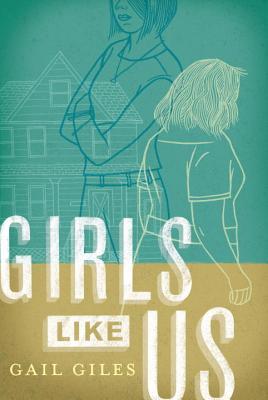
Girls Like Us by Gail Giles
With gentle humor and unflinching realism, Gail Giles tells the gritty, ultimately hopeful story of two special ed teenagers entering the adult world.
We understand stuff. We just learn it slow. And most of what we understand is that people what ain’t Speddies think we too stupid to get out our own way. And that makes me mad.
Quincy and Biddy are both graduates of their high school’s special ed program, but they couldn’t be more different: suspicious Quincy faces the world with her fists up, while gentle Biddy is frightened to step outside her front door. When they’re thrown together as roommates in their first "real world" apartment, it initially seems to be an uneasy fit. But as Biddy’s past resurfaces and Quincy faces a harrowing experience that no one should have to go through alone, the two of them realize that they might have more in common than they thought — and more important, that they might be able to help each other move forward.
Hard-hitting and compassionate, Girls Like Us is a story about growing up in a world that can be cruel, and finding the strength — and the support — to carry on.
shelved in General Fiction
synopsis from goodreads.com
With gentle humor and unflinching realism, Gail Giles tells the gritty, ultimately hopeful story of two special ed teenagers entering the adult world.
We understand stuff. We just learn it slow. And most of what we understand is that people what ain’t Speddies think we too stupid to get out our own way. And that makes me mad.
Quincy and Biddy are both graduates of their high school’s special ed program, but they couldn’t be more different: suspicious Quincy faces the world with her fists up, while gentle Biddy is frightened to step outside her front door. When they’re thrown together as roommates in their first "real world" apartment, it initially seems to be an uneasy fit. But as Biddy’s past resurfaces and Quincy faces a harrowing experience that no one should have to go through alone, the two of them realize that they might have more in common than they thought — and more important, that they might be able to help each other move forward.
Hard-hitting and compassionate, Girls Like Us is a story about growing up in a world that can be cruel, and finding the strength — and the support — to carry on.
shelved in General Fiction
synopsis from goodreads.com
Thursday, September 25, 2014
NEW in the FSHA Library
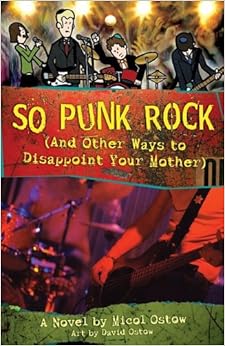
So Punk Rock (and other ways to disappoint your mother) by Micol Ostow
Despite his dreams of hipster rock glory, Ari Abramson's band, the Tribe, is more white bread than indie-cred. Made up of four suburban teens from a wealthy Jewish school, their Motley Crue is about as hardcore as SAT prep and scripture studies.
But after a one-song gig at a friend's Bar Mitzvah--a ska cover of "Hava Nagilah"--the Tribe's popularity erupts overnight. Now, Ari is forced to navigate a minefield of inflated egos, misplaced romance, and the shallowness of indie-rock elitism. It's a hard lesson in the complex art of playing it cool.
For more information, visit: www.kosherpunkrock.com.
Other links for So Punk Rock
The Tribe Myspace page: http: //www.myspace.com/tribenj
Ari on Twitter: http: //twitter.com/rockonari
Reena on Twitter: http: //twitter.com/NJchoirGRRL
shelved in General Fiction
synopsis from goodreads.com
Despite his dreams of hipster rock glory, Ari Abramson's band, the Tribe, is more white bread than indie-cred. Made up of four suburban teens from a wealthy Jewish school, their Motley Crue is about as hardcore as SAT prep and scripture studies.
But after a one-song gig at a friend's Bar Mitzvah--a ska cover of "Hava Nagilah"--the Tribe's popularity erupts overnight. Now, Ari is forced to navigate a minefield of inflated egos, misplaced romance, and the shallowness of indie-rock elitism. It's a hard lesson in the complex art of playing it cool.
For more information, visit: www.kosherpunkrock.com.
Other links for So Punk Rock
The Tribe Myspace page: http: //www.myspace.com/tribenj
Ari on Twitter: http: //twitter.com/rockonari
Reena on Twitter: http: //twitter.com/NJchoirGRRL
shelved in General Fiction
synopsis from goodreads.com
Subscribe to:
Posts (Atom)