Pages

Showing posts with label graphic novel. Show all posts

Tuesday, March 13, 2018

Tolog Review: Maus: A Survivor's Tale

Maus: A Survivor's Tale
by Art Spiegelman
reviewed by Teagan O'Hara

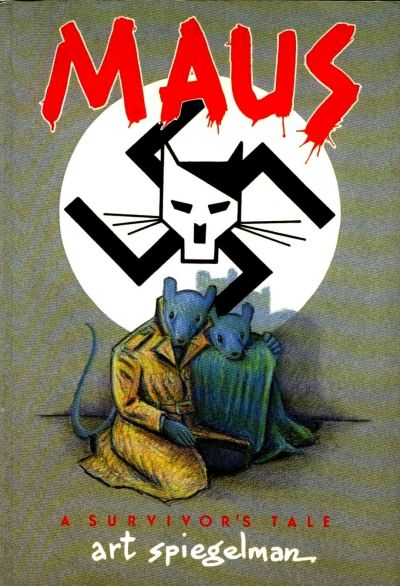
The intriguing graphic novel Maus by Art Spiegelman depicts one Jewish man and his family’s struggle to survive through war-torn Poland during World War II. “Artie,” the author, tells Vladek’s (his father) story with symbolic illustrations that portray the innocent Jews as mice, the truculent Nazis as cats, and the Polish as pigs.

With this multi-genre story, Spiegelman manages to make learning about the horrors of Jewish discrimination, the Holocaust, and the aftermath of the destruction of World War II even more interesting. The graphic novel includes both rough sketches of past events told by Vladek and Vladek’s current reactions to his retelling of the traumatizing memories. The toll the experience took on Vladek is evident throughout the book, as he frequently denies to go into detail on certain topics and reveals that he burned Artie’s dead mother’s journals that contained valuable accounts of her experiences.


Maus itself begins with one of Artie Spiegelman’s childhood memories. “If you lock [your friends] together in a room with no food for a week,” says Vladek Spiegelman, “Then you could see what it is, friends!” (Spiegelman 6). In the novel’s present day, Artie visits his father in New York to ask him about his experiences in the war. He records Vladek’s story on his tape recorder. The novel goes back and forth between the present and past with Artie’s own commentary on what Vladek says. Vladek speaks about his textile business, his marriage to Artie’s mother, his time in German ghettos, Auschwitz, and how he escaped.


When the first strips of Maus were first published in 1980, they received many positive comments and feedback from the public. However, some claimed that the representation of different races as different animals was inaccurate. Although the illustrations of the Jews as mice and the Germans as cats could be seen as one predatory species hunting another, there are many inconsistencies. Other than their tails and heads, the characters are really just human beings. Anja is afraid of mice (she is a mouse herself), characters have pets, and the “cats” use hunting dogs. Also, the depiction of the Polish as pigs could be potentially racist since Jews are known not to associate with pigs. Readers might also encounter some confusion in the second half of the book through Artie’s “identity crisis.” Instead of drawing himself and the people around him as certain animals that identify their race like he usually would, he crudely draws people with animal masks tied onto their faces.


Overall, this book is very fascinating to read. The artwork makes it easier for readers to understand what is going on. It provides a good visual aid to help with comprehension of the characters’ situations.

Thursday, November 7, 2013

New Arrivals: Graphic Fiction and Nonfiction

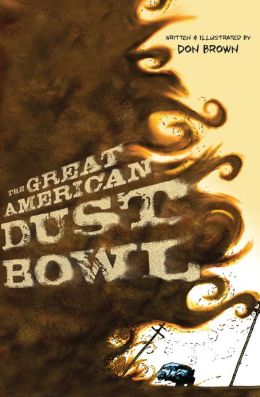
Concise and clear in imagery, text, and layout, Brown’s (Henry and the Cannons, 2013) nonfiction examination of the Dust Bowl contextualizes its genesis in geological and cultural history, the dynamics of its climatological presentation, and the effects on both the landscape and Depression-era High Plains farmers. The pen-and-ink artwork, digitally painted in burnished and dusty brown and yellow hues—and the shock of blue that comes with the rain that eventually clears the air—is combined with swirling text, along with well-researched and minimally descriptive explanations and occasional speech balloons attributed to anonymous residents and observers. The brevity of this presentation heightens rather than diminishes its power to evoke the history, and an ample list of resources provides plenty of opportunities for further research. A closing photo of the 2011 dust storm in Arizona emphasizes that the Dust Bowl wasn’t an isolated incident. This is a complete visual package, from the whirly, mud-colored cover design through the sudden reintroduction of color only after the dust storms abate. The Dust Bowl, as experienced by its survivors, truly comes to life in this compelling look at an important moment in American history.


\
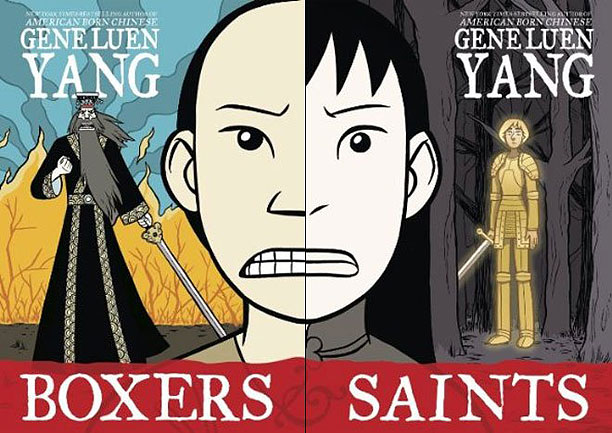
In American Born Chinese (2006), Yang spoke to the culture clash of Chinese American teen life. In Boxers—the first volume in a two-book set, concluding with Saints (2013)—about the Boxer Rebellion at the end of the nineteenth century in China, he looses twin voices in harmony and dissonance from opposite sides of the bloody conflict. Boxers follows a young man nicknamed Little Bao, who reacts to religious and cultural oppression by leading the uprising from the provinces to Peking, slaughtering “foreign devils” and soldiers along the way. Between the two books, Yang ties tangled knots of empathy where the heroes of one become the monsters of the other. Little Bao and his foil from Saints, Four-Girl, are drawn by the same fundamental impulses—for community, family, faith, tradition, purpose—and their stories reflect the inner torture that comes when those things are threatened. Yang is in superb form here, arranging numerous touch points of ideological complexity and deeply plumbing his characters’ points of view. And in an homage to the driving power of stories themselves, Bao is captivated by visions sprung from lore: the spirits he believes possess him and his fighters. Much blood is spilled as Little Bao marches toward his grim fate, which is even more unsettling given that Yang hasn’t fundamentally altered his squeaky clean, cartoonishly approachable visual style. A poignant, powerhouse work of historical fiction from one of our finest graphic storytellers.

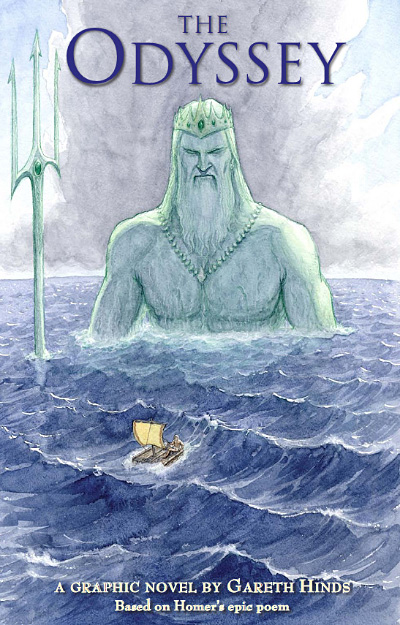
As the proliferation of recent Odyssey graphic novelizations approaches the record held by Shakespeare adaptations, it is perhaps appropriate that Hinds, the Bard’s premiere sequential adapter, should produce the most lavish retelling of Homer yet. Showing great artistic evolution since his rough-and-tumble Beowulf (2007), Hinds lets the epic story take its time, with a slow build and pages that aren’t afraid to alternate packed dialogue with titanic action. The sumptuous art, produced with grain, texture, and hue, evokes a time long past while detailing every line and drop of sweat on Odysseus’ face and conveying the sheer grandeur of seeing a god rise out of the ocean. Teens may be baffled by the hero’s commitment to the same pantheon of gods who heap trouble in his path, but they will not lose touch with the universal qualities of steadfastness that Odysseus still embodies. The mythic trials have seldom felt more grueling or genuine, and this makes a perfect pairing with Tim Mucci and Ben Caldwell’s adaptation for a slightly younger audience from the All-Action Classics series, affording a chance to see how an archetypal story can function so powerfully at both the realistic and the stylized ends of the artistic spectrum. A grand example of Hinds’ ability to combine historical adventure with human understanding.

reviews from Booklist

Wednesday, September 11, 2013

New Arrival: The War Within These Walls

741.5 SAX
on the West Wall of the Library
The War within These Walls

It's World War II, and Misha's family, like the rest of the Jews living in Warsaw, has been moved by the Nazis into a single crowded ghetto. Conditions are appalling: every day more people die from disease, starvation, and deportations. Misha does his best to help his family survive, even crawling through the sewers to smuggle food. When conditions worsen, Misha joins a handful of other Jews who decide to make a final, desperate stand against the Nazis.

Heavily illustrated with sober blue-and-white drawings, this powerful novel dramatically captures the brutal reality of a tragic historical event.


description from Eerdman's Publishing Co.

Sunday, June 23, 2013

Read it! The Complete Maus by Art Spiegelman

from barnesandnoble.com


The Pulitzer Prize-winning Maus tells the story of Vladek Spiegelman, a Jewish survivor of Hitler’s Europe, and his son, a cartoonist coming to terms with his father’s story. Maus approaches the unspeakable through the diminutive. Its form, the cartoon (the Nazis are cats, the Jews mice), shocks us out of any lingering sense of familiarity and succeeds in “drawing us closer to the bleak heart of the Holocaust” (The New York Times).
Maus is a haunting tale within a tale. Vladek’s harrowing story of survival is woven into the author’s account of his tortured relationship with his aging father. Against the backdrop of guilt brought by survival, they stage a normal life of small arguments and unhappy visits. This astonishing retelling of our century’s grisliest news is a story of survival, not only of Vladek but of the children who survive even the survivors. Maus studies the bloody pawprints of history and tracks its meaning for all of us.

Monday, June 3, 2013

Read it! Anya's Ghost by Vera Brosgol

from the ALAN Review

"Anya is a typical teen girl who is embarrassed by her family, struggling with her body image, and attempting to fit in at school. When she falls down a well, she thinks that this actually isn't the worst thing that has happened to her. At the bottom of the well, Anya finds a dead body and a new best friend—a ghost named Emily. At first Anya and Emily are close, but Anya realizes that some parts of the story Emily told about her death don't add up. As Anya struggles to sort out fact from fiction, she must also figure out life in high school. Emily begins to play dangerous pranks and Anya must clean up the mess. Brosgol's debut graphic novel provides a quirky, sardonic, and whimsical view into adolescence and the struggle to both fit in and be different from everyone else. Anya is sarcastic, caring, and thoughtful."