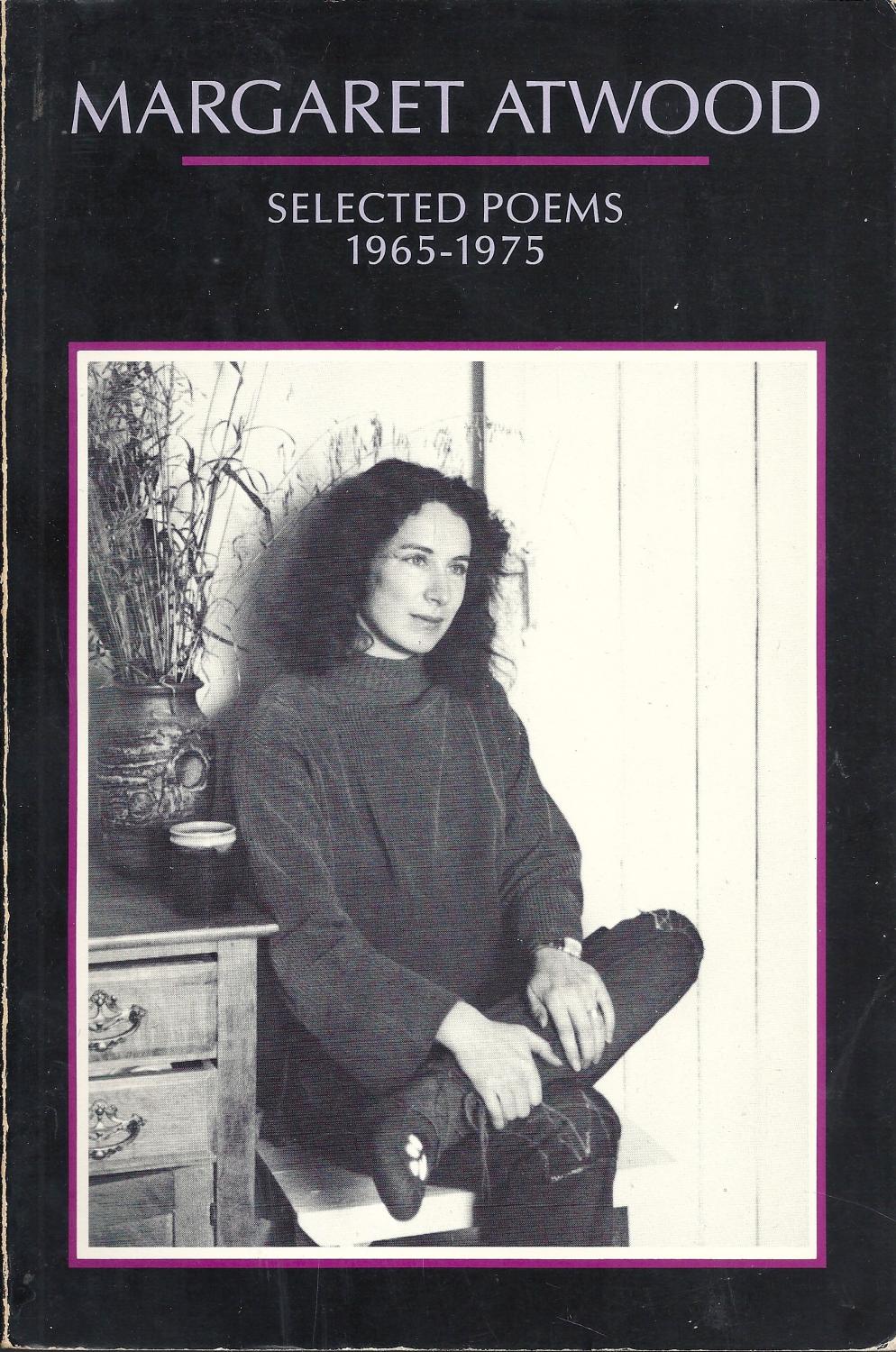
 Selected Poems: 1965-1975
by Margaret Atwood
reviewed by Ella Kitt
Selected Poems: 1965-1975
by Margaret Atwood
reviewed by Ella Kitt
Selected Poems: 1965-1975 by Margaret Atwood is an anthology of Atwood’s insightful and unembellished organic poetry. Throughout this selection, Atwood uses blunt language to create a lens through which readers can candidly observe raw human emotion. The use of a first-person narrative enables the reader to briefly enter into Atwood’s mind and view the world through her intensely perceptive eyes. She does an astounding job of depicting the beautiful and alluring aspects of life in conjunction with the utterly repulsive. Although her poems are thoroughly penetrating, Atwood seems to always leave room at the end for interpretation. Her style of writing does not force-feed information to the reader but rather gives the option to seek out the subtext within the poems.
While this book does not follow any specific plot, it is synthesized by the similar themes within Atwood’s poetry. She discusses all forms of life, such as animals and plants, with an immense amount of detail. These precise descriptions of something as ambiguous as the natural world add to the mysterious and eerie mood of her writing. Atwood puts a magnifying glass to the intangible with a central theme of isolation. Many of her characters alienate themselves from other people and eventually the world around them. This detachment leads to a sudden epiphany or introspective realization which highlights Atwood’s complex understanding of human relationships and emotions.
The majority of characters present in her poems are women who have been hurt or exploited in some way. Atwood delves into the objectification of women, a highly relevant subject in today’s social climate. She gives a powerful yet brief description of a toxic and abusive relationship when she says “you fit into me/ like a hook into an eye/ a fish hook/ an open eye” (Atwood 141). The terseness of this poem makes the pain caused by the abusive dynamic almost palpable. Atwood does this in many of her poems which is what makes her writing so fantastically compelling.
I would recommend this selection to young adults as it is extremely helpful in navigating and understanding human relationships. The intricacy of Atwood’s ideas conveyed in such concise language engrosses the reader in deep thought. This read is for those who want to gain a deeper understanding of the natural world and our emotional life within it.
 The Handmaid's Tale
by Margaret Atwood
reviewed by Isabella Durand
The Handmaid's Tale
by Margaret Atwood
reviewed by Isabella Durand
The Handmaid’s Tale by Margaret Atwood reveals an insight into a world where the population is dangerously low and women are deprived of all rights. In this dystopian novel, where women do not have control of their actions, bodies, or lifestyle, it is still relevant to today’s society and will be for years to come. Readers are informed of the events that happened in the city of Gilead by the narrator of this story, only known to us as Offred, and from her, we saw her world through her own perspective. Because of this, we are not even sure that what Offred is describing to us is completely true, but from what we can gather, that world is a place where no one wants to belong. This piece of dystopian-science fiction is dangerously close to a reality that might not be so far away and in reading this piece, really changes your perspective on our world today.
In the Republic of Gilead, the regime believes in a government where religion and politics come together, and this theocratic society, it mainly affects the women who inhabit this terrifying area. Because of these beliefs and style of government, women are not allowed to vote, read, write, or love, and for the Handmaids, life is even worse. To society, they are only vessels to carry children and help increase the population; they have no control over their lives. They are assigned to a distinguished couple and the Handmaid’s job is to conceive a child with the male, in Offred’s case, the Commander. They are forced to succumb to the wishes that other people have implanted into their minds and have to do exactly as they are told. This is why Offred is so important. Besides being the heroine in this novel, she realizes that what is happening is wrong, even if she can’t express the dialogue thoughts to actually come to this conclusion. Offred leads the plot of the story into different directions and through her actions, alters the course of her life. She went through ups and downs, accomplishments and failures, saw horrific events, made some mistakes, and eventually, took control of some of her actions. She was able to take the reigns of her life and actually make some choices for herself, even if they are not the best ones.
Laced throughout her novel, Atwood uses similar themes and motifs relating to the corrupted world in which the novel takes place to help the story flow. While reading The Handmaid’s Tale, women’s bodies and political opinions became a common theme throughout the story. Handmaids have no control over their bodies, and as previously mentioned, are like a vessel. Also, the regime running Gilead don’t care about women, only as long as they help the population increase. The events during the 1970s, when feminists made huge accomplishments for all women, were quickly forgotten and The Handmaid’s Tale shows the result of the depravity of these said rights. What is upsetting is the fact that, because women are only seen for their role in helping the population, they forget the joys of their previous life and only see themselves as a carrier. We the realization of her old life, Offred criticizes herself for wearing shorts or a swimsuit because, in Gilead, women seen dressed in clothes that were “revealing” are considered disgusting for the fact that they took appreciation of their bodies. Another theme is the titles and their roles, especially for women. Men have are given a military rank, for example the Commander, while women are reduced to stereotypical gender roles, such as Wives and Handmaids. They have been deprived of their names and are reduced to their position, not allowing any self-identity. Children who are deformed are given the title “Unbabies” and feminists are called “Unwomen”; these derogatory titles make you forget that they are human. Finally, an important motif in this theocratic government is the use of religious teachings and the way they change them to reflect their desires. The Commander reads Bible passages to Offred before they are to go to his room, but they are all passages twisted to reflect the needs of the government, almost as to justify their actions. Offred realizes this and even recognized that some of the passages that were told to them are not even from the Bible. The use of religion and politics is thoughtfully displayed and exemplified through the words of Margaret Atwood.
The tales of Offred seem so far-fetched and yet, in their own way, reflect today’s world, ultimately making this story so horrific. The Handmaid’s Tale is the story of Offred, a slave to the government, forced to play their rules. She is treated like an object who is only useful if she can become pregnant, and who also has to forget her old life. She remembers the days she would be with her husband and daughter, but now, everything is different. Her view on the world has been completely rearranged and her life is altered. This novel is her reflection on her own life, narrated by herself because her story is the one aspect of her life that she can control. We don’t know Offred very well because what we do know about her is based off of her description of herself, seen through her own opinion. In this dark tale, Offred finds comfort and nostalgia the memories of her life which helped her guide her actions.
In my opinion, I enjoyed this book and would recommend it to anyone living in today’s world because of the fact that is was made to reflect our own society. Thankfully, I have never experienced any of the traumas that Offred has to endure, but when reading this novel, it is hard not to picture yourself living in her situation. If you want another look at what the world could be like, or feminism is your thing, I believe that this is a novel that you will appreciate. One of my favorite lines comes from Offred’s “reconstruction” of some of the events in her life, speaking to herself in her head and addressing whoever would listen, she says, “...please remember: you will never be subject to the temptation or feeling you must forgive, a man, as a woman… But remember that forgiveness too is power. To beg for it is a power, and to withhold or bestow it is a power, perhaps the greatest.” She just wanted to leave her life as a Handmaid and was willing to forgive. Being the narrator of the story, she would tell it to herself and always hoped that someone would listen even though nobody could, or so she thought.
 The Handmaid's Tale
by Margaret Atwood
reviewed by Julieanna Gonzalez
The Handmaid's Tale
by Margaret Atwood
reviewed by Julieanna Gonzalez
Critically acclaimed author Margaret Atwood, tells of the dystopian life in the society of Gilead, in her horrifyingly realistic science fiction novel The Handmaid’s Tale. Her novel follows Offred, a Handmaid serving The Commander and his barren wife after the United States has fallen victim to a steep decrease in births. In the collapse of the Nation and the rise of the republic of Gilead, the government has stripped away all women’s rights, forcing those with viable ovaries to become Handmaids and bear children for their Commanders. Offred explains that the women in Gilead were, “ladies in reduced circumstances. That is what we are now. The circumstances have been reduced; for those of us who still have circumstances” (Atwood 8), because of the overly powerful Authoritarian government. Handmaids are never allowed to break the laws, express passionate feelings, show their bodies or faces and can never leave the position of a handmaid, or else they would be executed. Offred however, remembers her previous life of the years before, when she could live her life as she pleased and had a family and a job. But when everything she once knew changes in the blink of an eye, Offred is left in search of answers in a society where she is never allowed to go against the status quo, or else she could risk her life. Unsettling, sharply witted, evocative and scarily realistic, The Handmaid’s Tale is a haunting reminder of what modern society may one day retrogress to.
The Handmaid’s Tale deals heavily with the subjects of extreme authoritarian power, oppression of women, denatured sexuality and severe religious regimes. Atwood is especially keen in making the reader visualize the horrors these Handmaids have to endure, by using graphic imagery and impactful word choice that make the reader fully experience the raw human emotions of the characters. Atwood does not hold back in describing grotesque scenes with sickeningly vivid and graphic details, because it creates a stark contrast between the highly desensitized mindset of the people of Gilead and disturbing situations which are occurring within. She grips the reader with her mysterious and chilling writing style, full of seemingly innocent metaphors with dark underlying twists that put the reader on edge. Atwood’s characters are multi-faceted, and mysterious, especially Offred, who has incredibly frank, tongue in cheek narrations throughout the novel. Offred stands out from the other unsettlingly docile Handmaids, because she is highly sarcastic and rash in her thoughts and actions, but has very realistic, complex and deep emotions. She brushes with dangerous concepts and situations during the course of the novel, so she can keep alive the remaining sliver of humanity she still holds within her.
Though Atwood wrote this novel over three decades ago, she makes the realities of the modern world very fresh and apparent in her highly controversial dystopian novel, that puts trends like the current political climate and the state of women’s reproductive rights, into a scarily real perspective. The Handmaid’s tale was a very intense read with uncomfortable topics and content that may be very difficult to fathom for some readers. I do advise that this novel has graphic and disturbing content, so any reader who feels uncomfortable with these subjects should steer clear. However, I highly recommend The Handmaid’s Tale, to avid readers of dystopian science fiction, and fans of enigmatic and complex female protagonists, because of the gripping storyline and dark, unexpected twist and turns of the novel. I thoroughly enjoyed this novel, because of Margaret Atwood’s extremely refreshing and horrifying take on highly controversial subjects. I was completely engrossed by the intense and multi-layered characters, climatic action and shocking and swift plot twists of The Handmaid’s Tale.
