 Old School
by Tobias Wolff
reviewed by Olivia Roginson
Old School
by Tobias Wolff
reviewed by Olivia Roginson
Old School, by Tobias Wolff, follows the life of a young boy growing up in an all boy’s elite private school in 1960. The school is filled with only the most financially gifted, with the exception of the few boys lucky enough to receive scholarships. The narrator happens to be one of these scholarship students, bringing forth a sense of misfit, and a longing to belong in the other boys’ world. One thing to bring every student together is the common love for writing, and the thirst to become a noteworthy author. Willing to do anything to become a known writer and break from the reputation given to him by his family’s lack of wealth, the narrator pushes limits for success, while seeking the acceptance of his peers.
Although many things set apart the boys attending the prestigious prep school, one they can all agree on is that “A true piece of writing… can change your life.” They are all mesmerized by the notion that writing can affect how they perceive the world. The school’s noteworthy visits from well known authors, among whom are Robert Frost, Ayn Rand, and Ernest Hemingway, are events anticipated for by a majority of the student body. Along with meeting incredible authors, the boys compete in a writing competition for the chance to have a meeting with them. This highly coveted honor is one every student interested in writing strives for. The young boy followed by in Old School appears to want it just as much, if not more, than his fellow peers. “....I not only read writers, I read about writers.” (7) When his roommate wins the reading by Frost, the boy can’t help but feel envious.
The boy’s troubles are brought to their climax when it is revealed that his submission for the writing contest for Mr. Hemingway is proven to be plagiarized. The dishonesty in the boy’s paper, however, is the least of the school’s worries. Their reputation as an elite writer’s school is put in jeopardy, which stirs more trouble for the boy. “Schools like us are vulnerable to criticism… You have no idea of the damage you have done.” (144) This sense of needing approval of the outside world coincides with the internal struggles the boy faces, while interacting with his wealthy peers. The school sets the example that things you do can not only define you, but they can impact your reputation as well.
Old School provides the perspective of an outsider looking in, and describes the emotions brought forth when peers are forced to compete against each other for life changing opportunities. Though the power of writing is expressed throughout the novel, following the life of the boy outside of school proves to be more impactful. The boy’s realization that he needs to accept himself comes to light when he embraces his family’s heritage.
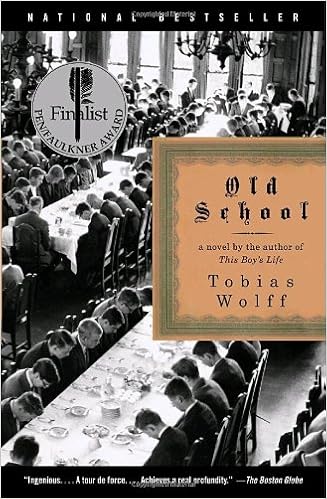 Old School
by Tobias Wolff
reviewed by Lauren Bolte
Old School
by Tobias Wolff
reviewed by Lauren Bolte
Old School by Tobias Wolff, a compelling literary fiction novel, describes the reality for boys attending an esteemed boarding school in the 1960s through the eyes of an observant and bright narrator. The school, well known for its writing and literary programs, pushes the students to devote their lives to becoming scholarly and attentive young men. Every couple of months, the school board invites a respected author to read through works that students submit as if they are entering a raffle. The author chooses the piece that they think deserves recognition, and the winner receives an audience with the renowned composer. This creates an extremely competitive environment for the talented students, leading to personal and communal conflict. Only one lucky boy will win the opportunity of a lifetime.
The narrator, a gifted student and writer, is attending the school on scholarship. He is expected to do well in all classes and succeed in his career as a writer. However, his roommate, Bill White, is in the same boat. The tensions build as authors such as Robert Frost and Ayn Rand speak at the school, but when it is announced that Ernest Hemingway is visiting, everyone is out for blood. The boys are forced to test the limits of loyalty, friendship, and creativity. As the reader, we are taken with the narrator through his experiences with writer’s block, unsupportive friends, and social drama. Most of the board members and teachers at the school are ruthless with their criticism, but some can relate with the boys and show preference for the ones that have true writing potential. The narrator’s supporters include Dean Makepeace and Robert Ramsey, two men with a lot of power at the school. The assist him through tough times with his work and other students. Although their help is not always direct, the narrator knows that they are the only ones he can trust at the cutthroat school. The visiting authors are not always what they seem through their work, and the narrator learns that writing changes with the writer, instead of the other way around. When his life takes a turn for the worst, he realizes that people see may see things very differently than you may think, and this can heavily affect your lifestyle. Tobias Wolff, the author, does an astonishing job of creating a visible connection between the characters and their very different perspectives of the world around them.
Imagery is a very vital device in the writing of a novel. The reader needs to be able to visualize the characters and setting in order to truly understand the meaning of the story. Tobias Wolff establishes a strong plot and emphasizes the crucial details with imagery and metaphors. He describes the setting of the school’s lawns as “a rich, unreal green against the muddy brown expanse of surrounding farmland….The chapel with its tall crenellated bell tower and streaming pennant looked like an engraving in a child’s book” (p.134). His creative storytelling allows the reader to feel as if they are truly in the novel with the characters. Tobias Wolff also has a way of leaving the reader hanging at the end of each chapter, like the end of a dramatic movie. It helps you to really think about the meaning of the chapter and how it will play out in the next one. At the end of chapter three, he describes the narrator’s experience in the library and ends with the following sentence: “I roe from my deep chair and crossed the room past boys dozing over books and exchanged the K volume for B” (p. 60). We are left wondering why he did this, and what it means for the rest of the book.
I would definitely recommend this book to readers that are looking for an enjoyable, yet thought-provoking novel. The genre is close to historical fiction, and it written to seem as if it is an autobiography. I thoroughly enjoyed reading Old School, and the author’s writing technique allowed me to connect the points covered throughout the book. Overall, it is a very captivating novel.
