 The Road
by Cormac McCarthy
reviewed by Briana Escobar
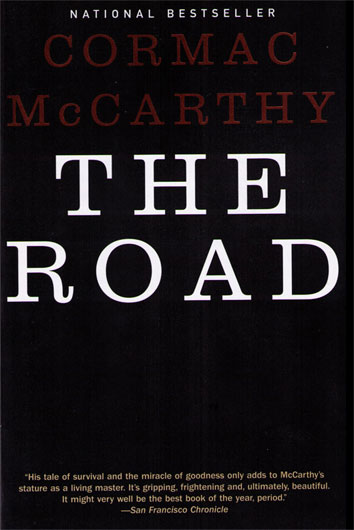
The Road
by Cormac McCarthy
reviewed by Briana Escobar
Cormac McCarthy’s The Road is a post-apocalyptic novel that uses a literary style that most authors do not dare to use when writing. McCarthy’s style is very mysterious, given that he doesn’t give the main character’s names at any point and his use of grammar is unorthodox. The lack of quotation marks when characters are speaking adds a certain wispy quality to the book. McCarthy’s technique unquestionably enhances the book’s eerie aura; post-apocalyptic novels can often be overdone or predictable, but The Road was not.
The story is about a man and his young son traveling on a road after firestorms have scourged the land, destroying civilization. McCarthy does an exceptional job of showing their fight for survival as they struggle to find food, water, shelter, and other basic necessities for life. The man and his son are very likable characters that are easy to become attached to. McCarthy allows us to look in on a genuine father-son relationship, one that is so full of unconditional love that it physically pains the reader as the son and father agonize and battle death. Not only does McCarthy show a strong familial bond, but also how tragedy changes humanity. Catastrophes can either bring out the best or the worst in people, and when food is gone and people are dying on the streets, societies become murderous.
Reading this novel opened my eyes to the extent that a parent will go for their child. It made me appreciate the life I have and how lucky I am that my society has not yet experienced a national tragedy. People around the world are living in hellish environments such as war zones or places that are taken over by terrorist groups, and while those places may not be at the same level as the civilization shown in The Road, McCarthy rightly sheds a light on issues throughout the world, which is especially important.
The Road
by Cormac McCarthy
reviewed by Kelly Carney
A young boy and his father never thought that they would wake up in a world of fire, ash, and dust. Most of the population is dead and the boy and his father are left lonely in a desolate, frightening America. Unsure of what happened, the boy and his father trudge through the whirling snow and the pounding rain trying to make it to the coast alive. They struggle to push an everyday industrial shopping cart with unstable wheels. The shopping cart carries all their belongings as well as the boy at times. There are a handful of other survivors; some that will do anything to survive and provide for their families, and the army, who the father describes as the “bad guys.” The “bad guys” are out all day and night searching to kill the remaining survivors. The boy and his father can’t trust anyone and have to make sure that their hiding places at night are not easily visible.
The father is constantly optimistic, reassuring the boy that they are far from death. The father mourns the death of his beautiful wife and the mother of his only child and often dreams of her face. Along the way, the boy and his father scour through houses searching for scraps of food survive. The dad and his son overcome the intense cold and life threatening illnesses in this harsh, yet heartwarming story about family, determination, and survival.
McCarthy uses exemplary imagery throughout the intense story, The Road. The story tells of an intense journey that is powered by hope. The Road will send shivers down the readers’ spines as they enter the world of the boy and his father. The father holds his son close and together they motivate each other to push through the journey, filling the reader with a warm sense of family and friendship. No matter the conditions, the boy and his father survive because they are “carrying the fire” (McCarthy 129), otherwise known as hope.
 The Road