The Tale of the Dueling Neurosurgeons
by Sam Kean
reviewed by Julia Yellen
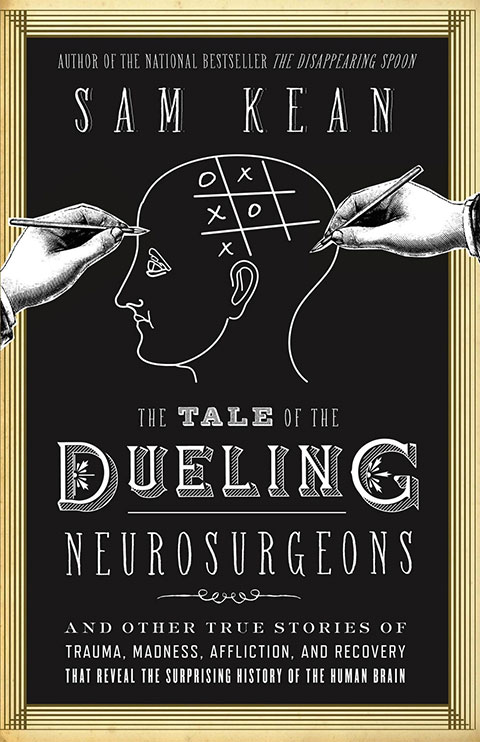
The Tale of the Dueling Neurosurgeons
by Sam Kean
reviewed by Julia Yellen
Sam Kean’s nonfiction-science novel, The Tale of the Dueling Neurosurgeons, brings readers on a journey through time, describing freak accidents and spontaneous illnesses. Kean skillfully dissects the history of our intricate brain with dozens of sufferers' immensely interesting and detailed anecdotes. The inner workings of our complicated brain remained a mystery to early neuroscientists, who relied mainly on tragedy to infer about it. The guess-and-check system revealed the brain’s many secrets by observing victims’ brain damage, insanity, and miraculous recovery over time. Scrutinizing thousands of injuries, neuroscientists concluded how almost all of our brain works and how the many parts work together. Readers dive into cases of kings, assassinators, cannibals, phantom limbs, pathological liars, giants, epileptics, and many more anomalies. We explore how our plastic brains wire and rewire themselves to survive, even against all odds, to compensate for lost skills. Masterfully written, the novel “illuminate(s) how the brain… work(s) (or fail(s) to)… and lays crucial groundwork for understanding how the brain influences the body” (Kean 194). While some stories remain tragic, others inspire, such as tales about blind adventures that learn to see with their tongues using echolocation.
A beautiful mix between history and science, the book reveals fresh insight on human resilience in the face of unimaginable struggle. Readers learn to love the heroes whose harsh experiences shaped modern neuroscience. Kean embraces humanity by sarcastically pointing out our flaws, but offers hope and sparks curiosity on the deeper questions of neuroscience. Kean uses cogent and funny language with a deeply interesting perspective on all aspects of the brain. This brilliant author does not write your average monotonous scientific article; this book is an exploration: an accumulation of inspiring and mind-blowing stories that will leave you wanting more from the minute you read the first page. Instead of boringly reciting brain scan studies and summarizing patients’ symptoms, Kean allows readers to experience victims’ feelings, living in their shoes for a chapter. We visualize what it is like to have synesthesia, a condition that blends senses, for example; imagine smelling key-lime-pie every time you see the number five. He tackles complicated subjects with witty narrating and expands our expectations of our brains’ capabilities. Each section unravels a new complication, starting with cells, senses, and circuits to movement and emotion to beliefs and delusions, and finally to memory, identity and consciousness. Fresh, new stories and chapters reveal closer insight and keep readers on their toes. I would recommend this wholeheartedly to anyone who loves to learn new things (scientific or not), but also enjoys reading many quick, compelling plots in one book. Of course the science-lovers will never put this book down, but it compels even the most cynical. I loved the deep-thinking aspect of the book and the wide diversity in stories. I greatly encourage you to pick this one up as soon as humanly possible to get a taste for yourself the brilliance that is Sam Kean and The Tale of the Dueling Neurosurgeons.
 A Brief History of Time
by Stephen Hawking
reviewed by Abigail Lewis
A Brief History of Time
by Stephen Hawking
reviewed by Abigail Lewis
The complexities of space and time are made clear in Stephen Hawking’s A Brief History of Time. In Hawking’s nonfiction book, he explains the concepts and theories of spacetime through simple explanations that a non-cosmologist human brain can comprehend. He starts with the basics of science in order to cover the more complex ideas. He questions popular religious beliefs and scientific theories about the beginning of time. In addition, past and modern theories of the universe, space, and time are discussed and explained with detail. Hawking teaches the history of the universe and explains the age old unanswered questions about spacetime and much more.
The concept of what is beyond the earth can be very difficult to understand to people, but Hawking does a spectacular job of making it clear. He uses simple language that everyone can comprehend to make sure that the concept is understood. Hawking makes sure that the basics are mastered because, “in order to talk about the nature of the universe and to discuss questions such as whether it has a beginning or and end, you have to be clear about what a scientific theory is”(Hawking 10). He also uses diagrams to help show the reader what it is that he is trying to describe. Hawking uses simple language that anyone can understand to describe more complex ideas. He states that, “by the wave/particle duality of quantum mechanics, light can be regarded as both a wave and a particle”(83). Then later goes into simpler terms by explaining that light can act like, “cannonballs, rockets, and planes”(83). Hawking is able to tell the reader what they need to know without confusing them.
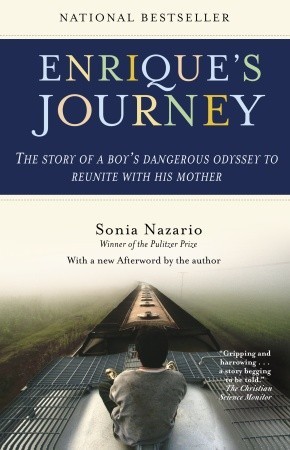
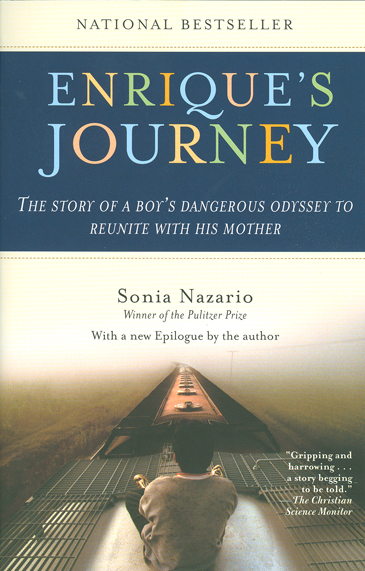
 Enrique's Journey
by Sonia Nazario
reviewed by Krista Celo
Enrique's Journey
by Sonia Nazario
reviewed by Krista Celo
Enrique’s Journey by Sonia Nazario is a suspenseful, eye-opening novel about the dangers that South American children are faced with as they flee poverty in their home country to journey to the United States. Conveyed from the perspective of a young Honduran boy, readers are shown the underlying, harsh truth of the treacherous journey these children must face to reach the United States. Enrique’s journey exposes readers to the real-life and concurrent adversity concerning immigration into the United States. Nazario puts this current debate of immigration into perspective, and gives us a strong view of the migrant’s lives.
From the moment Enrique’s mother stepped off of the porch, Enrique is unaware that his mother is leaving their home in poverty-stricken Honduras, to find work in the United States. While his mother is away, Enrique begins to grow angry and miserable imagining a life where his mother is there. Enrique, determined to escape unbearable circumstances, decides he will follow his mother to the United States. However, Enrique and other Central Americans know that it is not as easy as embarking a plane. These migrants must ride atop trains waiting to maim or kill them, while keep watch for dangerous gangs, spiteful immigration agents, and bandits waiting to strike. Enrique takes us alongside him through his physical and emotional journey, as he endures horrendous and death-defying conditions to reunite with his mother.
Enrique’s Journey is a well-written novel, told through the perspective of Enrique, but including many perspectives to show readers the important, yet avoided, issue of immigration. Nazario gives readers awareness into the experiences of Central American families who have no choice but to live separately in order to survive. Nazario digs deep within her heart-felt writing through an in-depth look at immigration and its effect on families. I personally enjoyed this novel, simply because I was able to gain a different perspective on life and receive insight on immigration into the United States.
 A Brief History of Time
by Stephen Hawking
reviewed by Tara Pugliese
A Brief History of Time
by Stephen Hawking
reviewed by Tara Pugliese
If you enjoy the thrill of challenging your mind and pondering the mysteries of the universe, read on; for, Stephen Hawking’s classic, nonfiction-science novel A Brief History of Time offers the reader just that. Hawking effortlessly explains complicated topics ranging from quarks in quantum mechanics to black holes in general relativity, yet the well-known physicist manages to succinctly articulate these complex concepts so as to facilitate the reader’s understanding. Thus, the intended audience broadens to include all intellectuals fascinated with such provoking questions as “Where did we come from? And why is the universe the way it is?” (Hawking vii).
A Brief History of Time appears rather intimidating, especially for those less knowledgeable in physics or astronomy; however, Hawking simplifies the many substantial issues for better comprehension. To aid the audience, Hawking includes no equations in the novel other than Einstein's famous E = mc^2. In addition, Hawking utilizes a surprising amount of humor to consistently engage the reader. Furthermore, the reader with quickly realize the resounding difference between Hawking’s classic and a typical physics course in school: understanding the universe also means discovering the meaning of the human existence and the significance of life and the presence -- or absence -- of God. As Hawking explains when discussing the future of science after the discovering of a universal theory for all of physics, “A complete, consistent, unified theory is only the first step: our goal is a complete understanding of the events around us, and of our own existence” (91).
I highly recommend A Brief History of Time to anyone fascinated in science, specifically theoretical astrophysics (i.e. the fun stuff like black holes and multiple universes). I also recommend this classic to those interested in religion and theology; for, Hawking mentions and debates the presence of a God (defined as any supernatural force driving or affecting the universe) consistently. That said, the included topics can become very difficult to process and understand, so lots of rereading may be necessary. Thus, I would not recommend this book as a “beach read.” In order to finish, you must have a strong desire for exploring this material and challenging your mind. However, the reward is powerful and fulfilling and lasting.
Enrique's Journey
by Sonia Nazario
reviewed by Marta Maynes
Enrique’s Journey by Sonia Nazario tells the astonishing story of a young Honduran boy on his journey to find his mother. Nazario transports readers to corrupt Central America, where she follows a boy named Enrique and narrates his unimaginable odyssey to reconnect with his mother in the United States. Like the majority of the immigrants traveling north and south through Mexico, Enrique must be a quick learner; he must master the art of riding atop trains, learn to hide from ‘la migra’, the cruel migration officers, learn how to beg for food, water, and shelter, and most importantly, never give up on reaching his destination.
Enrique must face many perilous dangers during his journey to the United States. He not only encounters the dangerous, “train of death” (Nazario), but also ruthless bandits and gangs who rob Enrique of the few pesos he carries. In addition, migrants run the risk of, “get raped or murdered” (Nazario). Enrique learns that he needs to be brave, confident, and clever to survive his treacherous odyssey to his ‘promise land’ where he and his mother will finally be reunited after 11 long years.
The Pulitzer Prize winner, Sonia Nazario, addresses the everyday struggles of immigrants looking to escape their economic and personal hardships in Enrique’s Journey. Nazario tells her story as if she were alongside Enrique. With her style of writing, readers feel more connected to the story and feel like they are in Enrique’s shoes, struggling along with him. Nazario’s vivid details and stories really make readers stop and reflect and realize how similar they are to the immigrants. Often, the media dehumanizes these migrants, but Sonia Nazario puts real faces to the many migrants struggling to reach their new beginnings. Nazario opens readers eyes and hearts to witness the grueling challenges faced by the immigrants traveling through Mexico to reach their personal ‘promise lands’.
 Enrique's Journey
by Sonia Nazario
reviewed by Megan Koehler
Enrique's Journey
by Sonia Nazario
reviewed by Megan Koehler
Enrique's Journey by Sonia Nazario is an eye-opening and heart wrenching non-fiction book about a boy trying to cross the border and find his mother in the United States. Enrique’s Journey takes place over a span of twenty-three years and tells the true story of a young boy named Enrique and his journey traveling from Honduras across Mexico and into the United States so he can see his mother again. His journey was far from easy, and he faced many difficulties along the way, including hunger, robbery, and drug problems.
On January 29, 1989, Enrique’s mother, Lourdes, left Enrique and his sister, Belky, with family members and departed poverty-stricken Honduras for the United States. Her plan was to get a job in the United States and send money back to her children so that they could go to school past the third grade and eventually move out of their thirty square foot shack. She promised her kids that she would be back in one year. Little did she know, life in the United States was not easy for immigrants and she would break that promise.
Enrique was seven when his mother left. As a teenager he had trouble at home without his mother. He started getting into trouble at school and getting into drugs at home. He missed his mother so terribly that he decided that he would set out alone and travel across Central America and Mexico to the United States. Eleven years after his mother left him, he left behind his sister and girlfriend in Honduras in search of his mother. He rode on top of trains through Mexico and Central America, in constant fear of falling off or being robbed and beaten by the gang members that control the trains. He finally makes it to the Rio Grande, but cannot get across without the help of a smuggler. He is penniless and does not have his mother’s phone number. Without her help, he has no chance of ever getting across the river and seeing her again.
Enrique’s Journey is a tragic tale of a young boy’s journey to find his mother. It is full of suspense and keeps you on the edge of your seat the entire time. I would recommend this book to anyone who is interested in the issue of illegal immigrants in the United States, and to anyone who enjoys stories about adventure and heartbreak. Will Enrique ever cross the Rio Grande and reach his mother in the United States? Read Enrique’s Journey to find out.
 The Tale of the Dueling Neurosurgeons